Friday, June 21, 2013

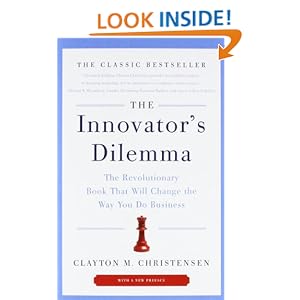
The Innovators Dilemma

Listened to this on Audible books commuting to Menlo Park for a Social Media for Nonprofits #SM4NP Conference. Good foundation, classic text on disruptive innovation and business.

Basic premise is not really that new and is pretty straight forward . . . "We cannot solve our problems with the same thinking we used when we created them." Einstein

In other words, the very business practices that make a company a success and enable it to grow are the ones that limit its ability to develop and sustain a new disruptive technology. Therefore, if a company is interested in maintaining its current scale and success as well as engage in developing new disruptive technologies it will need to to do so by acquiring or spinning out a small, flexible, independent, organization who's sole purpose is to focus on the disruptive technology and who's small scale matches the small scale of the new markets that will be "early adopters" of the new disruptive technology.

The three elements of a business: Values --> Processes --> Resources are very different in large, successful, established organizations that focus on incremental change vs. small, entrepreneurial organizations that focus on disruptive change.

Citizenville, Gavin Newsom

... How to Take the Town Square Digital and Reinvent Government.

Just barely started this one so no comment yet. Going to see Newsom speak at Dominican University on March 7th. More on this later.


6-21-13 While I don't always agree with Newsom, I found the book quite provocative in its indictment of our current governmental systems as bastions of Luddite driven bureaucracy, certainly not capable of engaging 21st century Gen X citizens. Citizens (and government officials) need better access to information. Government 2.0 is about improving constructive and well informed public engagement through enhanced digital access to information that is...

  • Searchable & Indexed (not in static pdf docs!!!)
  • Accessible via any device or platform through open source systems (Device Agnostic)
  • Share-able - not limited by onerous copyright restrictions (an alternative would be to use Creative Commons licencing agreements); not locked down with restrictions that  impede re-use of the information - should be "remixable" or "mashable" via opensource API's (Application Programming Language); connected to public feedback systems (blog comments and other social media tools)
  • Free - the government should not charge for access or licence sole rights to the information to a third party distributor that can charge for access.
A few additional resources in this arena:

Open Government Data Videos

Tuesday, May 21, 2013

Too busy to be ...


When our hyper-linked, multitasking minds become as fragmented and compartmentalized as our computers we will become as soulless as they are. The future may be less about increasing AI toward a state of self-directed consciousness and more about decreasing our humanity into a state of hollow, self-absorbed, utilitarianism. Are we already on the path toward making ourselves unconscious slaves to a world of conscious machines?

Monday, April 22, 2013

Precautionary Principle

My friend Renee and I were talking about this yesterday so I did a little research ...

From Wikipedia ...

  • One of the primary foundations of the precautionary principle, and globally accepted definitions, results from the work of the Rio Conference, or "Earth Summit" in 1992. Principle #15 of the Rio Declaration notes:
"In order to protect the environment, the precautionary approach shall be widely applied by States according to their capabilities. Where there are threats of serious or irreversible damage, lack of full scientific certainty shall not be used as a reason for postponing cost-effective measures to prevent environmental degradation."

  •   ... an implicit reversal of the onus of proof: under the precautionary principle it is the responsibility of an activity proponent to establish that the proposed activity will not (or is very unlikely to) result in significant harm.
  • The application of the precautionary principle is hampered by both lack of political will, as well as the wide range of interpretations placed on it. One study identified 14 different formulations of the principle in treaties and nontreaty declarations.[7] R.B. Stewart (2002)[8] reduced the precautionary principle to four basic versions:


  1. Scientific uncertainty should not automatically preclude regulation of activities that pose a potential risk of significant harm (Non-Preclusion PP).
  2. Regulatory controls should incorporate a margin of safety; activities should be limited below the level at which no adverse effect has been observed or predicted (Margin of Safety PP).
  3. Activities that present an uncertain potential for significant harm should be subject to best technology available requirements to minimize the risk of harm unless the proponent of the activity shows that they present no appreciable risk of harm (BAT PP).
  4. Activities that present an uncertain potential for significant harm should be prohibited unless the proponent of the activity shows that it presents no appreciable risk of harm (Prohibitory PP).