Thursday, June 23, 2016
Parable of the Polygons
Here is a link (http://ncase.me/polygons/) to a simple but powerful online tool/game demonstrating the unintended mechanisms behind discrimination and segregation. It's kind of like the dark side of the complexity behind flocking behavior in which simple rules for individual behavior results in complex emergent outcomes - i.e. Institutional racism and social segregation as an unintended outcome of seemingly unrelated, disconnected and "harness" personal choices.


Thursday, June 26, 2014
Dominican Leadership Series Videos - Alex Pentland, Lt. Governor Gavin Newsome, Senator Elizabeth Warren
If you missed any of these events, you can now watch them on: Marin TV, Education
Channel 30. Check the program listings at Community Media
Center of Marin - http://cmcm.tv/
 |
Alex
Pentland
Social
Physics: How Good Ideas Spread - The Lessons From a New Science
Wednesday, August 6,
2014
If the Big
Data revolution has a presiding genius, it is MIT's Alex "Sandy" Pentland.
Over years of groundbreaking experiments, he has distilled remarkable
discoveries significant enough to become the bedrock of a whole new
scientific field: social physics. Social Physics: How Good Ideas Spread-The
Lessons From a New Science will change the way we think about how we learn
and how our social groups work.
|
 |
Lieutenant
Governor Gavin Newsome
Citizenville
Wednesday, August 27, 2013
A rallying
cry for revolutionizing democracy in the digital age, Citizenville reveals
how ordinary Americans can reshape their government for the better. Gavin
Newsom, the lieutenant governor of California, argues that today's government
is stuck in the last century while-in both the private sector and our
personal lives-absolutely everything else has changed. The explosion of
social media, the evolution of Internet commerce, the ubiquity of smart
phones that can access all the world's information; in the face of these
extraordinary advances, our government appears increasingly irrelevant and
out of touch.
|
Despite your political perspective on Newsom this is a must watch for anyone interested in Digital Citizen Engagement and Democracy 2.0.
 |
Senator
Elizabeth Warren
A Fighting Chance
Wednesday, September 3, 2013
In this
passionate, funny, rabble-rousing book, A Fighting Chance, Warren shows
why she has chosen to fight tooth and nail for the middle class-and why she
has become a hero to all those who believe that America's government can and
must do better for working families. Elizabeth Warren is the senior senator
from Massachusetts. A former Harvard Law School professor, she is the author
of eight books.
|
Wednesday, June 25, 2014
Visual Thinking, Innovation and Idea Card Decks
Here's a reprint of an article (on the Xplane blog) I just read about a tangible tool to use visual thinking to solve problems and generate new ideas. Yellow highlights = my emphasis (i.e. parts I think are super cool).
I often jot down my bits and bytes of ideas in my journal and then later cull through it to write articles or project proposals. The key, as noted below, is to have a "tagging system" so you can "see patterns" as they emerge. I do this (in my journal) with a consistent header for each item (date, person, headline, icon) and icons that I draw next to each piece of information (star person for a person reference, book icon for a resource reference, idea balloon for a quote etc.). Also the reason blogs work so well as a place to dynamically aggregate information - "its the tagging stupid" - blogs are just the front end of a dynamic database system for gathering, tagging, and rearranging information.
Always fun to come across an article with interesting background context connecting a personal practice to something larger.

 Dmitri Mendeleev was the first scientist to order the elements by atomic mass, resulting in what is now the periodic table. Mendeleev carried a deck of cards – each with an element and some of its known properties – using time on train rides to play “chemical solitaire” and look for patterns.
 Herman Hollerith developed a machine that could tabulate statistics by reading information encoded on physical cards through the placement of holes in a grid. Hollerith’s invention revolutionized the field of data statistics and marked the beginning of the computing age. His Tabulating Machine Company later became IBM.
 Vladimir Nabokov, author of many novels including Lolita, composed his work using an index card-based method, assembling stories in fragments. In an interview with The Paris Review, Nabokov described his card method: “The pattern of the thing precedes the thing. I fill in the gaps of the crossword at any spot I happen to choose. These bits I write on index cards until the novel is done. My schedule is flexible, but I am rather particular about my instruments: lined Bristol cards and well sharpened, not too hard, pencils capped with erasers.”
I often jot down my bits and bytes of ideas in my journal and then later cull through it to write articles or project proposals. The key, as noted below, is to have a "tagging system" so you can "see patterns" as they emerge. I do this (in my journal) with a consistent header for each item (date, person, headline, icon) and icons that I draw next to each piece of information (star person for a person reference, book icon for a resource reference, idea balloon for a quote etc.). Also the reason blogs work so well as a place to dynamically aggregate information - "its the tagging stupid" - blogs are just the front end of a dynamic database system for gathering, tagging, and rearranging information.
Always fun to come across an article with interesting background context connecting a personal practice to something larger.
Card Decks: Tactile Tools for Pattern-Finders, Integrative-Thinkers and Inspiration-Seekers
Leave a reply
By Stephanie Gioia
What do the Table of Elements, the first IBM computer, and the novel Lolita have in common? Before they were icons of human achievement, they were card decks.
What gives card decks this unique power to create new meaning in the world? The basis of visual thinking is the analysis (i.e. disaggregation) of a complex idea into “nodes”, followed by the synthesis (i.e. reintegration) of those “nodes” through “links” into a new meaningful whole. At the most basic level, cards are “nodes” in search of “links”. Card decks as a problem-solving tool are powerful because we often know the parts of a problem or solution, but we don’t yet know how they fit together in an insightful way.
Dmitri Mendeleev was the first scientist to order the elements by atomic mass, resulting in what is now the periodic table. Mendeleev carried a deck of cards – each with an element and some of its known properties – using time on train rides to play “chemical solitaire” and look for patterns.
Visual Thinking Tip: When looking for a pattern or structure to bring meaning to complex information, break information into movable nodes and seek multiple possible configurations until the relationships within the system comes into focus.
Herman Hollerith developed a machine that could tabulate statistics by reading information encoded on physical cards through the placement of holes in a grid. Hollerith’s invention revolutionized the field of data statistics and marked the beginning of the computing age. His Tabulating Machine Company later became IBM.
Visual Thinking Tip: “Code” your individual cards in as many ways as possible, using symbols and colors to categorize information. Structure may later emerge from this metadata.
Vladimir Nabokov, author of many novels including Lolita, composed his work using an index card-based method, assembling stories in fragments. In an interview with The Paris Review, Nabokov described his card method: “The pattern of the thing precedes the thing. I fill in the gaps of the crossword at any spot I happen to choose. These bits I write on index cards until the novel is done. My schedule is flexible, but I am rather particular about my instruments: lined Bristol cards and well sharpened, not too hard, pencils capped with erasers.”
Visual Thinking Tip: Save your thoughts in fragments – a memorable quote, a midnight brainstorm, a crucial statistic, a sketch – to maintain a pool of content that can be assembled or reassembled for multiple possible uses. Communicating your ideas to audiences that vary in their perspectives and needs is much easier when you can rapidly pull the most relevant content or storytelling approach for each audience.
Learn more about how to make and use card decks at www.deckaholic.com.
Monday, December 2, 2013
Liberating Structures: Farewell to the Traditional Small Group Breakout?
Here's an interesting group process that I wanted to "bookmark" on this blog.
At CompassPoint, we've been exploring and testing out methods to liberate our group work from processes that feed us into routine patterns and default ways of thinking. At our recent staff meeting, consultant Alan Silva introduced us to a few of the 33 frameworks provided on the eponymous website Liberating Structures, which offers exercises for teams to engage in group work to unleash creativity and fresh ideas. The impetus behind these frameworks is that "conventional structures are either too inhibiting (presentations, status reports and managed discussions) or too loose and disorganized (open discussions and brainstorms) to creatively engage people in shaping their own future." Do you agree? It's certainly worth a try, isn't it? |
Wednesday, October 23, 2013
6 Useful iPad Apps for Creating Tutorials and Screen Casts
Yesterday Anna came home very excited at having been asked by her teacher to produce a Khan Academy like tutorial on multiplying decimals for her classmates using Educreations. She gave me a very enthusiastic tour of the app and proceeded to spend the next hour or so practicing with the tool to create a variety of "mock" tutorials comparing the iPhone to a Windows phone, how to do basic addition with illustrated flowers as the "prop" etc.
I was impressed and inspired to find out more about "screencast" tools and did a bit of web research to find out what else was available. The best, most concise article I found (in my extensive 20 minute research) was in a website called Educational Technology and Mobile Learning. I don't want to forget these resources (I'd like to start using screencasts in my work) so I decided to "bookmark" them here in a blog post. Here's the link http://www.educatorstechnology.com/2013/05/6-useful-ipad-apps-for-creating.html and below is the article


I was impressed and inspired to find out more about "screencast" tools and did a bit of web research to find out what else was available. The best, most concise article I found (in my extensive 20 minute research) was in a website called Educational Technology and Mobile Learning. I don't want to forget these resources (I'd like to start using screencasts in my work) so I decided to "bookmark" them here in a blog post. Here's the link http://www.educatorstechnology.com/2013/05/6-useful-ipad-apps-for-creating.html and below is the article
-----------------------------------------------------------------------
By definition, a screencast is a recording of your computer screen accompanied by audio narration.In the past, screencasting tools used to cost a fortune and only tech savvy people were able to use them but thanks to web 2.0 technologies, there are now dozens of easy to use and simple platforms to record your screencast. Educational Technology and Mobile Learning has already featured several of these tools in previous posts. Today, however, I am going to share with you some of the best iPad apps to create screencasts and tutorials. Check them out below and let us know what you think of them. Enjoy
2- Teach
3- Show Me
6- Pixntell
Friday, June 21, 2013
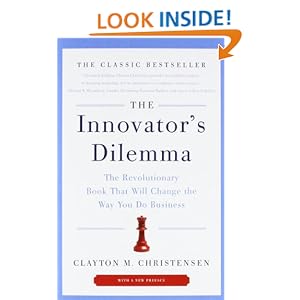
The Innovators Dilemma
Listened to this on Audible books commuting to Menlo Park for a Social Media for Nonprofits #SM4NP Conference. Good foundation, classic text on disruptive innovation and business.
Basic premise is not really that new and is pretty straight forward . . . "We cannot solve our problems with the same thinking we used when we created them." Einstein
In other words, the very business practices that make a company a success and enable it to grow are the ones that limit its ability to develop and sustain a new disruptive technology. Therefore, if a company is interested in maintaining its current scale and success as well as engage in developing new disruptive technologies it will need to to do so by acquiring or spinning out a small, flexible, independent, organization who's sole purpose is to focus on the disruptive technology and who's small scale matches the small scale of the new markets that will be "early adopters" of the new disruptive technology.
The three elements of a business: Values --> Processes --> Resources are very different in large, successful, established organizations that focus on incremental change vs. small, entrepreneurial organizations that focus on disruptive change.
Basic premise is not really that new and is pretty straight forward . . . "We cannot solve our problems with the same thinking we used when we created them." Einstein
In other words, the very business practices that make a company a success and enable it to grow are the ones that limit its ability to develop and sustain a new disruptive technology. Therefore, if a company is interested in maintaining its current scale and success as well as engage in developing new disruptive technologies it will need to to do so by acquiring or spinning out a small, flexible, independent, organization who's sole purpose is to focus on the disruptive technology and who's small scale matches the small scale of the new markets that will be "early adopters" of the new disruptive technology.
The three elements of a business: Values --> Processes --> Resources are very different in large, successful, established organizations that focus on incremental change vs. small, entrepreneurial organizations that focus on disruptive change.
Citizenville, Gavin Newsom
... How to Take the Town Square Digital and Reinvent Government.
Just barely started this one so no comment yet. Going to see Newsom speak at Dominican University on March 7th. More on this later.

6-21-13 While I don't always agree with Newsom, I found the book quite provocative in its indictment of our current governmental systems as bastions of Luddite driven bureaucracy, certainly not capable of engaging 21st century Gen X citizens. Citizens (and government officials) need better access to information. Government 2.0 is about improving constructive and well informed public engagement through enhanced digital access to information that is...
Just barely started this one so no comment yet. Going to see Newsom speak at Dominican University on March 7th. More on this later.
6-21-13 While I don't always agree with Newsom, I found the book quite provocative in its indictment of our current governmental systems as bastions of Luddite driven bureaucracy, certainly not capable of engaging 21st century Gen X citizens. Citizens (and government officials) need better access to information. Government 2.0 is about improving constructive and well informed public engagement through enhanced digital access to information that is...
- Searchable & Indexed (not in static pdf docs!!!)
- Accessible via any device or platform through open source systems (Device Agnostic)
- Share-able - not limited by onerous copyright restrictions (an alternative would be to use Creative Commons licencing agreements); not locked down with restrictions that impede re-use of the information - should be "remixable" or "mashable" via opensource API's (Application Programming Language); connected to public feedback systems (blog comments and other social media tools)
- Free - the government should not charge for access or licence sole rights to the information to a third party distributor that can charge for access.
A few additional resources in this arena:
- 2009 White House Open Government Directive http://www.whitehouse.gov/open/documents/open-government-directive
- Open Government Foundation
- Sunlight Foundation
- Knight Foundation's Community Information Challenge
- Open Government Platform
- Open Government Data
Tuesday, May 21, 2013
Too busy to be ...
When our hyper-linked, multitasking minds become as fragmented
and compartmentalized as our computers we will become as soulless as they are.
The future may be less about increasing AI toward a state of self-directed consciousness
and more about decreasing our humanity into a state of hollow, self-absorbed, utilitarianism.
Are we already on the path toward making ourselves unconscious slaves to a
world of conscious machines?
Monday, April 22, 2013
Precautionary Principle
My friend Renee and I were talking about this yesterday so I did a little research ...
From Wikipedia ...
From Wikipedia ...
- One of the primary foundations of the precautionary principle, and globally accepted definitions, results from the work of the Rio Conference, or "Earth Summit" in 1992. Principle #15 of the Rio Declaration notes:
"In order to protect the environment, the precautionary approach shall be widely applied by States according to their capabilities. Where there are threats of serious or irreversible damage, lack of full scientific certainty shall not be used as a reason for postponing cost-effective measures to prevent environmental degradation."
- ... an implicit reversal of the onus of proof: under the precautionary principle it is the responsibility of an activity proponent to establish that the proposed activity will not (or is very unlikely to) result in significant harm.
- In some legal systems, as in the law of the European Union, the application of the precautionary principle has been made a statutory requirement.[1]
- The application of the precautionary principle is hampered by both lack of political will, as well as the wide range of interpretations placed on it. One study identified 14 different formulations of the principle in treaties and nontreaty declarations.[7] R.B. Stewart (2002)[8] reduced the precautionary principle to four basic versions:
- Scientific uncertainty should not automatically preclude regulation of activities that pose a potential risk of significant harm (Non-Preclusion PP).
- Regulatory controls should incorporate a margin of safety; activities should be limited below the level at which no adverse effect has been observed or predicted (Margin of Safety PP).
- Activities that present an uncertain potential for significant harm should be subject to best technology available requirements to minimize the risk of harm unless the proponent of the activity shows that they present no appreciable risk of harm (BAT PP).
- Activities that present an uncertain potential for significant harm should be prohibited unless the proponent of the activity shows that it presents no appreciable risk of harm (Prohibitory PP).
A Few Buckminster Fuller Quotes and my reflections (in Green)
[Design Science is] the effective application of the principles of science to
the conscious design of our total environment in order to help make the
Earth's finite resources meet the needs of all humanity without disrupting the
ecological processes of the planet.
--- R. Buckminster Fuller
The last part of the above quote ... "make the Earth's finite resources meet the needs ..." Sounds very much like the Brundtland Commission's definition of sustainability, which coined what has become the most often-quoted definition of sustainable development: "development that meets the needs of the present without compromising the ability of future generations to meet their own needs."
It is not for me to change you. The question is, how can I be of service
to you without diminishing your degrees of freedom?
--- R. Buckminster Fuller
My own working assumption of why we are here is that we are here as
local-Universe information-gatherers and that we are given access to the
divine design principles so that we can therefrom objectively invent
instruments and tools -- e.g., the microscope and the telescope --
with which to extend all sensorial inquiring regarding the rest of
the to-the-naked-eye-invisible, micro-macro Universe, because human
beings, tiny though we are, are here for all the local-Universe
information-harvesting and cosmic-principle-discovering, objective
tool-inventing, and local-environment-controlling as local Universe
problem-solvers in support of the integrity of eternally regenerative
Universe.
--- R. Buckminster Fuller
And the summary version below. I like the short one for brevity but the long one for the filler detail.
We are most probably here for local information-gathering and
local-Universe problem-solving in support of the integrity of eternally
regenerative Universe.
--- R. Buckminster
We humans are manifestly here for problem-solving and, if we are any good
at problem-solving, we don't come to utopia, we come to more difficult
problems to solve."
--- R. Buckminster Fuller
I live on Earth at present,
and I don't know what I am.
I know that I am not a category.
I am not a thing -- a noun.
I seem to be a verb,
an evolutionary process --
an integral function of the universe.
--- R. Buckminster Fuller
I like the idea of thinking of myself as a Verb.
The most important fact about Spaceship Earth:
an instruction manual didn't come with it.
--- R. Buckminster Fuller
There is something patently insane about all the typewriters sleeping
with all the beautiful plumbing in the beautiful office buildings --
and all the people sleeping in the slums.
--- R. Buckminster Fuller
We are on a spaceship; a beautiful one. It took billions of years to develop.
We're not going to get another.
--- R. Buckminster Fuller
You can't better the world by simply talking to it. Philosophy
to be effective must be mechanically applied.
--- R. Buckminster Fuller
The case for being a practitioner, a maker, a doer, a published writer, or an artist in a gallery at some point in your life. Also the case for "reflection in action" and "ready, fire aim"
When individuals join in a cooperative venture, the power generated far
exceeds what they could have accomplished acting individually.
--R. Buckminster Fuller
The case for collaboration!!!!
You never change things by fighting the existing reality. To change
something, build a new model that makes the existing model obsolete.
--- R. Buckminster Fuller
Don't fight forces, use them
--- R. Buckminster Fuller
If the Success or Failure of this Planet, and of Human Beings,
Depended on How I Am and What I Do,
How Would I Be? What Would I Do?
--- R. Buckminster Fuller
A twist on "What would Jesus do?" Or "If you knew you only had a short time to live would you be doing what you're doing today?"
Love is omni-inclusive,
Progressively exquisite,
Understanding and tender
And compassionately attuned
To other than self.
--- R. Buckminster Fuller
There is no such thing as a failed experiment, only experiments
with unexpected outcomes.
--- R. Buckminster Fuller
How can we make the world work for 100 percent of humanity in the shortest
possible time through spontaneous cooperation without ecological damage or
disadvantage to anyone?
--- Buckminster Fuller (1895-1983)
Shortened and combined with concept of sustainability - "How can we make the world work for 100% of humanity, present and future, without disadvantage to anyone or any living thing?
I learned very early and painfully that you have to decide at the outset
whether you are trying to make money or to make sense, as they are mutually
exclusive.
--- R. Buckminster Fuller
How often I found where I should be going only by setting out for
somewhere else.
--- Buckminster Fuller
Making the journey is what it's all about!
The importance of man in the next generation of technical research is very
much greater than in the previous. The computer cannot ask an original
question. The computer can only reask questions which were originally asked
by the human brain. No computer can apprehend the plurality of potentially
significant patterns newly emergent in evolution. Men will continue and
flourish as the great question askers and exploratory inventors.
--- R. Buckminster Fuller
Sunday, March 31, 2013
Fellow Conservatives, by Jonathan Rowe in West Marin Review Fall 2010
I just read the following prose and it so captured the irony and paradox of life in Marin . . .
Wednesday, March 13, 2013
Explore. Dream. Discover.
Twenty years from now you will be more disappointed by the things you didn't do than by the ones you did do. So throw off the bowlines. Sail away from the safe harbor. Catch the trade winds in your sails. Explore. Dream. Discover.Mark Twain (perhaps not!? H. Jackson Brown, Jr. published the work containing the quotation, but he did not take credit for it. The book “P.S. I Love You” contained a collection of wise aphorisms from Brown’s mother.)
What is it that confers the noblest delight? What is that which swells a man's breast with pride above that which any other experience can bring to him? Discovery! To know that you are walking where none others have walked; that you are beholding what human eye has not see before; that you are breathing a virgin atmosphere. To give birth to an idea -- an intellectual nugget, right under the dust of a field that many a brain-plow had gone over before. To be the first -- that is the idea. To do something, say something, see something, before anybody else -- these are the things that confer a pleasure compared with other pleasures are tame and commonplace, other ecstasies cheap and trivial. Lifetimes of ecstasy crowded into a single moment.
- Innocents Abroad
Wednesday, February 27, 2013
Fall of Giants, Ken Follett
I love historical novels and this a doozy at 985 pages! Here's the Amazon blurb ... Ken Follett’s magnificent new historical epic begins, as five interrelated families move through the momentous dramas of the First World War, the Russian Revolution, and the struggle for women’s suffrage.
It's book one of a trilogy. Looking forward to the rest (once I finish this one).

It's book one of a trilogy. Looking forward to the rest (once I finish this one).
Flight Behavior, Barbara Kingsolver
Recently finished this novel. Classic Kingsolver - excellent narrative voice that captures the characters and culture of the community (rural Apalachia). Although the "environment vs. economy" story is not new the use of fiction to bring it to life works well. Hopefully the medium of fiction and Kingsolver's engaging style will bring the global warming, climate issue, to light for many new people that might be unfamiliar with some of the concepts and details presented in this book.

Books, Blogs, Articles and More . . .
I've added a new advanced widget tool to my sidebar that will aggregate all posts labled as "WhatI'mReading" to track my thoughts on things I read. Hope to me bigger thana list but shorter that a full blog post. Let's see how this works . . .
Friday, September 14, 2012
Arithmetic
Here's an emailed blurb about campaign finance that I found quite insightful and to the point (kind of scary too!). Full disclosure - it came from the Obama campaign.
Sheldon Adelson, the conservative billionaire Las Vegas casino owner, has pledged to give up to $100 million -- whatever it takes -- to defeat Barack Obama.
We know it's not out of love for Mitt Romney, so why part with so much money? As President Clinton reminded us last week, sometimes the answer is as simple as arithmetic.
So let's do the math: According to a new report from the Center for American Progress Action Fund, Adelson could see up to $2 billion in savings under Mitt Romney's tax plan versus the President's plan. That's how much Romney's policies would favor millionaires and billionaires.
If Mitt Romney wins -- $2 billion more for Adelson. If Barack Obama wins, millionaires and billionaires pay their fair share.
It's a highly cynical but straightforward calculation
Monday, September 10, 2012
Deep Patriotism
"Deep
patriots don't just sing the song, 'America the Beautiful' and then go home. We
actually stick around to defend America’s beauty -- from the oil spillers, the
clear-cutters and the mountaintop removers. Deep patriots don't just visit the
Statue of Liberty and send a postcard home to grandma. We defend the principles
upon which that great monument was founded -- 'give me your tired, your poor,
your huddled masses yearning to breathe free.'"
-Van
Jones
A Thought provoking quote for today. Excellent in reclaiming patriotic symbols in service of valuing the collective investment required to sustain both "America the Beautiful" and "America the melting pot".
Also made me think about "Slow Patriotism" (a la Slow Food, Slow Money . . .) - that the investment required is a long-term investment not a quick-fix.
Interesting in reading more from Rebuild the Dream . . . click here

Subscribe to:
Posts (Atom)